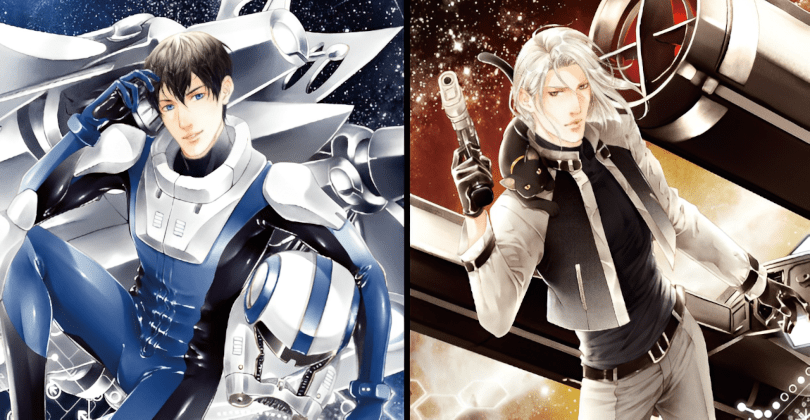
Author: 唇亡齿寒 / Lips Gone, Teeth Cold
Translator: Kinky || https://kinkytranslations.com/

Appendix 2
The author has something to say: This appendix is included in the collection, providing references and origins of the characters’ names.
– Lagrange: Joseph-Louis Lagrange, a French mathematician and physicist. His numerous achievements in mathematics are particularly dreaded by students.
– Planck: Max Planck, a German physicist, the founder and pioneer of quantum physics, and the 1918 Nobel Prize winner in Physics.
– Pythagoras: An ancient Greek mathematician and philosopher, known for discovering the Pythagorean theorem, also known as the theorem of right-angled triangles.
– Von Neumann: John von Neumann, who proposed the binary and stored-program concepts, is known as the “father of modern electronic computers.”
– Schrödinger: Erwin Schrödinger, an Austrian physicist and one of the founders of quantum mechanics, famous for his “Schrödinger’s cat” thought experiment.
– Pavlov: Ivan Petrovich Pavlov, a Russian physiologist, psychologist, and physician, known for his work in classical conditioning. He conducted famous experiments with dogs and won a Nobel Prize.
– Descartes: René Descartes, a French philosopher, physicist, mathematician, and physiologist, known as the founder of analytical geometry.
– Bayes: Thomas Bayes, a British mathematician, best known for Bayes’ theorem.
– Leibniz: Gottfried Wilhelm Leibniz, a German philosopher and mathematician who, alongside Newton, independently invented calculus.
– Cavendish: Henry Cavendish, a British chemist and physicist. His descendants established the renowned Cavendish Laboratory in his honor.
– Kepler: Johannes Kepler, a German astronomer, mathematician, and philosopher, recognized as the father of modern optics. He developed the Keplerian telescope and discovered the three laws of planetary motion, earning the title “Legislator of the Skies”.
– Gauss: Carl Friedrich Gauss, a German mathematician, physicist, astronomer, and geodesist, often referred to as the “Prince of Mathematicians.”
– Faraday: Michael Faraday, a British physicist and chemist, who proposed the law of electromagnetic induction and discovered the laws of electrolysis.
– Shannon: Also known as Claude Shannon, the founder of information theory.
– Euler: Leonhard Euler, a Swiss mathematician and physicist, who is regarded alongside Gauss as one of the greatest mathematicians.
– Turing: Alan Turing, a British mathematician and logician, considered the father of computer science and artificial intelligence. He laid the groundwork for computer logic and introduced the concepts of the “Turing machine” and the “Turing test”.
– Fourier: Jean-Baptiste Joseph Fourier, a French mathematician and physicist, who discovered Fourier’s law.
– Taylor: Brook Taylor, a British mathematician, known for Taylor’s theorem.
– Hovland: Carl Hovland, one of the four pioneers of communication studies.
– Lasswell: Harold Lasswell, another pioneer of communication studies.
– Joanna: Queen Joanna of Castile, known as “Joanna la Loca” or “Joanna the Mad,” daughter of Ferdinand II and Isabella I, sister to Queen Catherine, wife of Philip I, and mother of Charles V.
– Giorgione: Originally named Giorgio Barbarelli da Castelfranco, an Italian painter of the Venetian school during the Renaissance, a student of Giovanni Bellini, and a mentor to Titian.
– Titian: Tiziano Vecellio, a Renaissance painter of the Venetian school, a student of Giovanni Bellini and a fellow student of Giorgione. He was knighted by Charles V (the son of the aforementioned Joanna).
– Frankenstein: Refers to Victor Frankenstein, the mad scientist from the novel “Frankenstein”, written by Mary Shelley, wife of the British poet Percy Bysshe Shelley.
– Figaro: A character from the operas The Barber of Seville and The Marriage of Figaro.
<<< || Table of Contents || >>>
 Kinky Translations