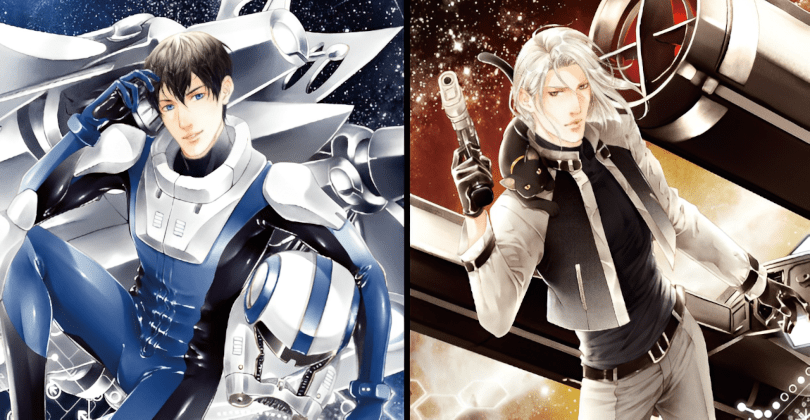
Author: 唇亡齿寒 / Lips Gone, Teeth Cold
Translator: Kinky || https://kinkytranslations.com/

Interlude 3
In the Standard Calendar year 1277, it was destined to be an extraordinary year. This year, I, Jacob Yutz, led a fleet headed by the “Child of the Wind”, traversing half of the galaxy to reach humanity’s cradle—Old Earth.
Humankind has been out of this cradle, which nurtured the great civilization of the galaxy, for thousands of years. As is well known, continuous external expansion created most of the human-inhabited star systems now called “colonies”. In human history, conflicts and frictions between colonies and the mother country have never been rare, and even after leaving Earth and entering the vast cosmos, these conflicts were inevitable.
According to exact historical records, in the year 2507 of the Common Era, the colonies completely broke away from the mother country—Old Earth. The colonies, in their thirst for freedom and wealth, severed all ties with Old Earth, isolating the mother planet in a remote region of a spiral arm of the galaxy. Afterward, the colonies entered a golden age, with significant strides in economy, technology, and culture. However, greater conflicts lurked in the shadows of history, mocking humanity. Soon, wars erupted among the individual colonial planets, quickly spreading to all star systems without exception. Later historians called this the “First Galactic War”, akin to the naming of wars on Earth.
The protracted war destroyed the foundation of human civilization. The economy quickly collapsed, and after overthrowing the belligerent governments, people were left directionless. During the long war, technology regressed, and people forgot the great technologies that had brought them out of the cradle. Where once spaceships could reach the speed of light, most planets couldn’t even produce a spaceship capable of space travel.
The Great Decline. Indeed, only such a term can describe the regression of human civilization at that time. If advanced extraterrestrial civilizations had been watching us, they would have surely laughed out loud at our backwardness.
Fortunately, the Great Decline didn’t last long—only six centuries. In the long span of human history, this is negligible. Six centuries later, in the year 3275 of the Common Era, the light of human civilization’s revival dawned. A spaceship from Old Earth landed on colonial soil, its passengers being remnants of Old Earth, led by Nassar Chabais, the first King of the Galactic Empire. Unfortunately, I, Jacob Yutz, wasn’t born in that era and could only imagine his grand achievements through the sparse records left by posterity.
When human civilization almost regressed to the Middle Ages, Old Earth still retained advanced technology, much of which still seemed like “miracles” to people today. However, inevitable resource depletion and environmental degradation forced the people of Old Earth to abandon their homeland and embark on another exodus. They traveled on near-light-speed ships, journeying for six centuries across half the galaxy, and landed on a planet with an environment similar to Earth. This planet was named “The Unfallen Star”, a title given by later generations, hoping it would never fall or disappear.
Like Jesus Christ’s arrival in ancient religions, the first wave of Earth’s descendants saved humanity from darkness. They spread ancient yet advanced technologies, bringing people out of the darkness and back into the light of civilization. To govern the scattered planets, the leader of the first wave of Earth’s descendants, Nassar Chabais, proclaimed himself King of the Galactic Empire and granted titles and fiefs to his followers. While some democrats might see this as foolish, one must admit that it was an effective method for that era. Emperor Nassar I also changed the calendar, canceling the Common Era and starting the “Standard Calendar”, marking a new epoch for humanity, with everything needing rejuvenation.
During his reign, King Nassar I also made mistakes, such as imposing heavy taxes on colonial planets, which stirred rebellious sentiments on many frontier planets. In Standard Calendar year 47, the “Great Uprising” occurred, with 131 planets declaring independence. At that time, this number was nearly a third of the Empire’s territory. The 131 planets, deprived of technological and economic support, had essentially signed their death warrants.
However, perhaps by the will of a higher power, the human race didn’t perish. In Standard Calendar year 53, the second wave of Earth’s descendants arrived in the colonies. They had set out a year later than the first wave but, due to various reasons during the long interstellar journey, arrived half a century later.
Fearing that the technology possessed by the latecomers would threaten his rule, Emperor Nassar I ordered the second wave of Earth’s descendants to be hunted down. Driven to desperation, the second wave was welcomed by the 131 independent planets. They came to the frontier, gathered representatives of all independent planets, and declared the establishment of the “Galactic Federation”. From then on, the galaxy entered a state of rivalry between the Empire and the Federation. Although small-scale wars frequently occurred, humanity indeed emerged from the shadow of the Great Decline post-war. The technology brought back by the two waves of Earth’s descendants revitalized human civilization, allowing humanity to survive in the vast universe.
Thus, another millennium passed. In history, this was a period of stable development. But like a blooming flower, there must be a moment of its most beautiful bloom. For the galaxy, this “bloom” occurred in Standard Calendar year 1195. That year, the third wave of Earth’s descendants arrived in the colonies, specifically on a planet neither part of the Empire nor the Federation—Neo Athens.
The speed of their ship, the “Dante”, was far inferior to the previous waves, causing them to arrive a thousand years later, despite only a few years delay in departure. But the technology brought by the third wave was no less advanced. In the final moments of Old Earth, wise scientists created artificial intelligence—not the AI found in ordinary computers but self-aware, independently thinking AI. This unprecedented invention was installed on the “Dante”, guiding the third wave of Earth’s descendants after a thousand years of slumber.
As the last people to stay on Old Earth, the third wave of Earth’s descendants were mostly scientists and technicians. Unlike the politically ambitious first and second waves, they were solely interested in technology and scholarship. They modeled their system after ancient Athens, establishing a parliament and administrative council, electing a chief executive and government officials, and founding the “Neo Athens Academy”, open to all who sought knowledge and science. To defend the city-state, they built three space carriers named after the ancient Greek sages Socrates, Plato, and Aristotle. To manage the city, they created three high-end AIs named Beatrice, Mona Lisa, and David, after figures from the Renaissance era.
In the grand star map of the galaxy, Neo Athens was undoubtedly the brightest star. She symbolized the second Renaissance, guiding humanity towards enlightenment. Centered on Neo Athens, technology, stagnant for a thousand years, saw rapid progress. In less than a century, the warp engines of spaceships were upgraded four times, eliminating the need for space teleportation stations for interstellar travel.
Thanks to the fifth-generation warp engine, my ship, the “Child of the Wind”, could complete a six-century journey in six months, heading to Old Earth for exploration. As for why I wanted to visit that long-forgotten mother planet, perhaps it was nostalgia in my blood or some legends that sparked my innate curiosity. I had heard that after the third wave of Earth’s descendants left, some people remained, led by Kester, the last scientist of Old Earth and inventor of high-end AI. Maybe after the third wave left, Kester and the other scientists created some great miracles? Perhaps they thrived on Old Earth using more advanced technology?
No one knew the answers. And I would find them.
In Standard Calendar year 1277, I, Jacob Yutz, led a fleet on a journey to Old Earth. At that time, I had no idea it would turn into a life-threatening adventure.
Because six months later, I encountered “Yasha” on Old Earth, as its creator called it, a name meaning a terrifying monster in some language of Old Earth. But to me, it was the ultimate killing machine capable of destroying humanity.
—”Records of the Old Earth Expedition,” Prologue, by Jacob Yutz.
The author has something to say:
Note: The setting of “Yasha” references the Shrike from “Hyperion” by Dan Simmons.
<<< || Table of Contents || >>>
 Kinky Translations